
Resources ... Let Us Know How Can Help
If you plan to purchase your first or tenth home, start here. Buying property in Massachusetts is not difficult, but it's helpful to understand and be aware of the local customs before you start your search. Our goal is to help guide you toward the best decision for your unique situation. To do this, we believe that a well-informed client will ultimately be the most satisfied, too. We look forward to discussing the current market conditions and trends with you - most important, we can't wait to help you discover your dream home!
Check out our on demand home buyer video seminar here! After registering, you'll have instant access to our on demand buyer consultation and we'll immediately mail (USPS) your home Massachusetts Home Buyer Booklet. It include everything you need to buy a home in Massachusetts - even sample forms. Click here to get access now!
Selling your home is a big decision. It's not just about moving, it's about identifying a proven seamless process that will help maximize the value of current property within a timeline that meets your specific needs.
There's no doubt that this can be a stressful process, but after successfully selling 100s of homes, we've identified the smoothest processes, most effective marketing strategies and negotiation techniques to ensure the highest sale price with the least amount of hassle. Contact us today for a no obligation consultation.
Senior Options
Connect with experts to discuss senior living options. Knowing where to begin is the hardest part, so we've included a few helpful resources below:
Home Hazards
Asbestos - Asbestos.com provides a Guide to Asbestos in The Home ... it outlines common asbestos locations, related heath concerns and how to deal with asbestos when it's found. Tips on how to hire an asbestos remover can also be found at asbestos.com.
Lead Paint - Slowly phased out in the 1960s and 1970s, lead paint was ultimately outlawed in residential use in 1978. Consequently, all homes older than 1978 are suspect; however, there are many ways to mitigate lead paint and costs can vary. In recent years, the government has eased mitigation requirements to encourage lead compliance. The below sites provide additional information about lead paint safety ... you can even search property to see if it's been tested for lead paint.
Mass.gov - Search property testing history
Massachusetts Childhood Lead Poisoning Prevention Program’s Lead Safe Homes 1.0 database
New England Lead Prevention - Information for home buyers, tenants, landlords, etc.
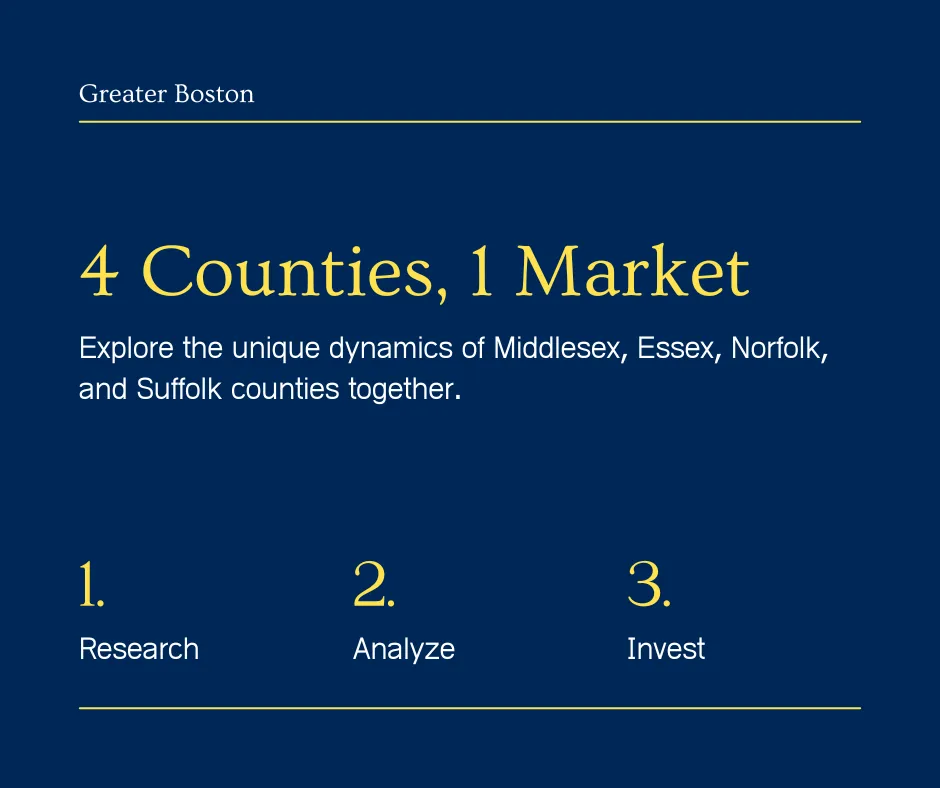
Essex vs. Middlesex: When the County Line Matters to Your Offer Price
Most buyers shopping the Greater Boston market hear two town names and assume they're roughly comparable. They aren't. Cross a county line in this region and the same square footage, the same school-district reputation, even the same commute can sit at materially different price points — sometimes for very real reasons, sometimes for legacy ones that haven't caught up to the data.
Here's what the line actually does, and when it should change how you write your offer.
The four counties that make up Greater Boston
The Mike Hughes Team works across Middlesex, Essex, Norfolk, and Suffolk counties. Each has its own assessor offices, its own registry of deeds, and its own mix of housing stock — but the practical pricing differences come from three drivers, not from county borders themselves.
- School-district reputation — anchored at the town level, not county. A Wellesley address (Norfolk) and a Lexington address (Middlesex) trade on school reputation premiums, not which county they happen to sit in.
- Commuter access to Boston — distance + transit availability. North Andover (Essex) commutes very differently than Newton (Middlesex), even though both are family-trade-up markets.
- Local tax burden + assessment culture — towns set property tax rates. The county line affects how you research the public records, not what you pay annually.
Where the county line genuinely matters for an offer
Public records research
Different counties = different registry of deeds offices. Pulling deed history, mortgage history, or prior sale data for a Lynnfield property (Essex County) means searching the Essex Southern District Registry. The same kind of search for a Reading property (Middlesex County, but bordering Lynnfield) routes through Middlesex Southern. If you're doing pre-offer due diligence on prior sales or financing patterns, you need to know which registry to query — and small mistakes can mean missing recent transfers.
Permit history paths
Permits are filed at the municipal level (city/town building inspector), not the county. So the county line doesn't change your permit research — but the cross-county comparison work in a CMA does. A Boston (Suffolk) comp pulled from the Boston ISD permit database doesn't tell you anything about a Lynnfield (Essex) target unless the buyer's agent and listing agent both understand each town's permit norms.
Tax-assessment timing
Each town sets its own assessment cycle. Some towns reassess on a three-year cycle; others annually. When you're using the assessed value as a sanity-check on a list price, you need to know how stale that town's assessment is — and that's a town-by-town fact, not a county-wide one.
Where it doesn't matter as much as buyers expect
The borders that buyers tend to over-weight:
- The Middlesex–Essex line near Reading and Lynnfield — pricing on either side of this line is mostly driven by school district and commuter rail access, not the county itself.
- The Norfolk–Middlesex line through Newton/Brookline — both towns trade at premium pricing on village-level reputation, not on which county hosts them.
- The Suffolk–Norfolk line through Milton/Hyde Park — Boston neighborhood transitions matter more than the county boundary.
How a sharp buyer's agent uses this
When a property catches your interest, the right questions aren't "which county?" — they're:
- What does the comp set look like in this submarket (within 0.5–1 mile)?
- What's the school-district story, and is the listing accurately representing it?
- What's the commute pattern from this address — and is it priced accordingly?
- What does the registry of deeds show for prior sale and refinance history?
- What's the assessor-to-market gap right now, and what does that imply about tax stability?
Get those right, and the county line is a research routing detail — not a pricing decision.
The bottom line
Greater Boston is a four-county market. Treating it as one homogeneous region misses real pricing differences; treating each county as a hard pricing boundary creates phantom differences that don't exist. The team's job is to know where the line actually moves the number, where it doesn't, and how to research correctly on each side.
Working with a buyer or seller in the Essex–Middlesex–Norfolk–Suffolk corridor and want a specific submarket read? Contact the Mike Hughes Team — we work the four counties as one connected market, and we'll tell you when the county line matters and when it doesn't.

Other Useful Tools
Financing ... everyone's budget and cash flow is different. Whether you you get paid on a salary, hourly, bonus or commission basis, understanding your monthly obligation is critical when buying a home.
Here is a link to a mortgage calculator to help you start your planning.
Explore A Career in Real Estate!
Real estate can be a very rewarding career ... each day we have the opportunity to meet and help new people! Being able to help someone start a new stage of life is an extremely gratifying experience.
It's relatively easy to get started, but knowing where and how to start is the biggest challenge. Unfortunately, the state licensing exam doesn't cover any marketing or business planning ... so new agents are often left to sink or swim! In 2023, the National Association of Realtors estimates 10,000 agents are being forced to leave the business each month!
After being in business for 20+ years, I've been able to help many buyers, sellers AND agents succeed. Getting started the right way with the right company can make or break an new agent. eXp Realty is now selling more homes than any other brokerage, so we have tools and training to help you succeed. Moreover, it would be my pleasure to introduce you to the company's tools, answer any questions that you have about the business and share my systems and training so that you are able to quickly launch your new business. Let's connect!