
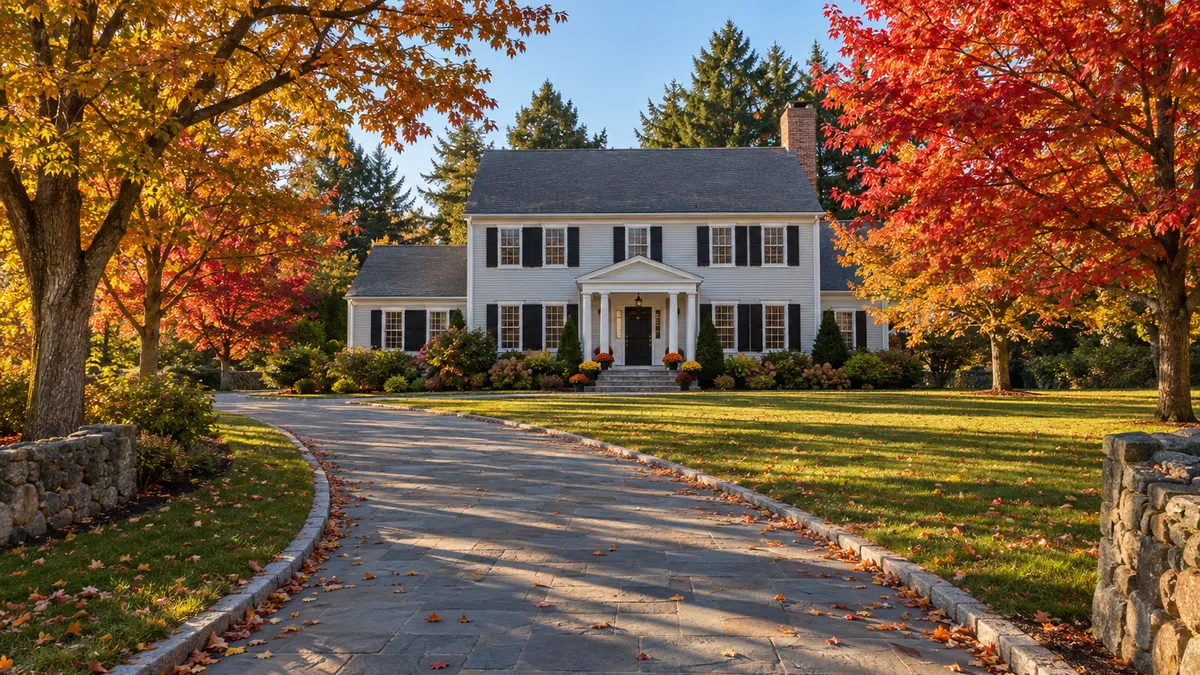
Why Weston Is Known for Estate Living | Mike Hughes Team
Weston, Massachusetts: Where Estate Living Finds Its True Home
Just a short drive from the energy of Newton, Waltham, and Watertown sits a town that operates by a different set of standards. Weston, Massachusetts has long held a reputation as one of Greater Boston's most distinguished addresses, and that reputation is grounded in something tangible. It is not marketing language. It is land, legacy, and a community that has deliberately chosen to preserve both.
If you are exploring luxury real estate in the Greater Boston area, understanding what sets Weston apart is not just useful, it is essential. The Mike Hughes Team works across Newton, Waltham, and Watertown every day, and when clients ask where estate-scale living truly begins in this region, the answer almost always circles back to Weston.
The Land Itself Tells the Story
Weston's most defining characteristic is its lot sizes. The town maintains strict zoning regulations that require substantial minimum acreage for residential parcels. According to the Town of Weston's official zoning bylaws, much of the town's residential land falls under zoning designations requiring one to two acres at minimum, with many estate properties sitting on five, ten, or even twenty or more acres.
That scale is rare this close to Boston. Weston sits roughly 12 miles west of downtown Boston, according to the Massachusetts Department of Transportation, yet it feels entirely removed from urban density. When you arrive at a Weston estate, you are not navigating a tight cul-de-sac. You are turning down a long private drive, often bordered by mature hardwoods, stone walls, and open meadow.
Those stone walls are not just decorative. Many trace property boundaries that have been in place for well over a century, a quiet reminder that Weston's character as a landed community has deep historical roots.
Architectural Range That Rewards Discerning Buyers
Weston's housing stock spans centuries and styles, and that variety is part of what makes the market compelling. You will find:
- Federal and Colonial Revival homes from the 18th and 19th centuries, often with original wide-plank floors and restored period details
- Mid-century modern estates designed by notable New England architects, prized for their clean lines and integration with the landscape
- Contemporary custom builds from the past two decades, featuring open floor plans, smart-home systems, and resort-caliber amenities
- Sprawling Shingle Style properties with wraparound porches and thoughtful additions that honor original craftsmanship
The common thread is not style, it is quality. Weston buyers and the architects who serve them have consistently prioritized materials and craftsmanship over square footage alone. That philosophy shows up in finished details, in the way rooms relate to the landscape outside, and in long-term value retention.
Privacy as a True Amenity
In luxury real estate, privacy is not a checkbox. It is an amenity that buyers will pay a meaningful premium to secure. Weston delivers it structurally. The town's low density, combined with its abundant tree canopy and topographical variation, means that neighbors on even adjacent parcels are rarely visible from the main residence.
Gated entries, long setbacks, and mature landscape buffers are standard features across the upper tier of Weston's market. For buyers coming from more densely developed communities closer to Boston, the contrast is immediate and striking.
Conservation Land Surrounding the Community
Weston has made a sustained commitment to open space preservation. According to the Weston Forest and Trail Association, the town protects more than 1,000 acres of conservation land laced with walking and equestrian trails. That preserved land surrounds and weaves through residential areas, ensuring that the pastoral quality of the landscape is not at risk of being developed away.
For estate buyers, this matters enormously. The view from your back terrace in Weston is not at the mercy of a future subdivision. The forest behind a Weston property is likely to remain forest, and that permanence adds real, calculable value to the holdings it borders.
Proximity Without Sacrifice
One of the most common misconceptions about Weston is that its privacy comes at the cost of convenience. It does not. Weston sits at the intersection of Route 128 and the Massachusetts Turnpike, two of Eastern Massachusetts's primary highway corridors according to MassDOT. Commutes to Newton, Waltham, Cambridge, and downtown Boston are measured in minutes rather than hours under typical conditions.
The Weston commuter rail station on the Fitchburg Line connects residents to North Station in Boston, and Logan International Airport is accessible via multiple highway routes. Estate living in Weston is not a retreat from the world. It is a well-positioned base from which to engage it on your own terms.
A Market That Moves Carefully and Holds Value
Weston's luxury market is not characterized by rapid turnover. Properties at the estate level tend to trade infrequently, and when they do, they attract buyers who have done serious homework. That deliberate pace reflects both the caliber of sellers and the expectations of buyers in this segment.
According to the Greater Boston Association of Realtors, Weston consistently ranks among the highest median sale price markets in Middlesex County. That sustained positioning reflects the structural scarcity of estate-scale land this close to a major metropolitan area. You cannot manufacture more Weston. What exists is what will ever exist, and that constraint supports long-term value in a way that more abundant markets simply cannot replicate.
What Buyers at This Level Are Actually Looking For
Working across Newton, Waltham, and Watertown gives the Mike Hughes Team a clear view of what buyers in Greater Boston's luxury segment are genuinely seeking. The request list is consistent:
- Land that creates a buffer from neighbors and street noise
- Architecture with a point of view, not a production builder aesthetic
- Outdoor spaces that function as extensions of the home, not afterthoughts
- Infrastructure that supports modern life: high-speed connectivity, generator backup, robust mechanical systems
- A community with a stable, long-established character
Weston meets each of those criteria with consistency. That alignment between buyer priorities and what the town actually delivers is why clients who explore Weston rarely stop exploring it. They start making offers.
Is Weston the Right Fit for Your Search?
Estate living is not about square footage or a list of amenities. It is about a quality of daily experience that feels earned and sustainable. Weston provides that in a way that is genuinely rare within reasonable distance of Boston.
Whether you are comparing Weston against Newton's most established neighborhoods, considering how it stacks up against properties in the broader 128 corridor, or simply trying to understand the landscape before you commit to a search, the Mike Hughes Team is here to walk you through it with honesty and local depth.
Reach out to the Mike Hughes Team at mikehughesteam.com or call 617-433-9225 to start a conversation about what estate living in the Greater Boston area looks like for your specific goals. We know this market, and we are ready to help you navigate it.